

Abstract
Wealth concentration threatens freedom when it allows a few actors to set conditions for access to work, information, and essential services without effective oversight by those affected. This article examines how contracts, public policies, and technological dependencies connect private gains, decision-making power, and the allocation of costs. It brings the author's three books into dialogue with official investigations, empirical studies, and legal sources. It presents a flowchart, an illustrative accumulation simulation over ten and twenty years, and a practical framework based on accessible documents. The argument is that infrastructure control can enable actors to constrain choices and shift risks to people with fewer resources to refuse them. The proposed response combines public oversight, workable exit options, and broader sharing of benefits. The result is an investigative and governance framework aimed at protecting the material conditions for exercising rights.
Keywords: artificial intelligence; economic concentration; strategic coordination; vulnerability; cognitive sovereignty; democratic control.
1 Concentration as a problem of freedom
A society can produce more while distributing the power to decide who benefits ever more unequally. When work, communication, credit, and essential services depend on infrastructure controlled by a few actors, economic concentration reaches the material conditions for exercising rights. The central issue is the capacity to impose those conditions and resist their revision.
The World Inequality Report 2026 estimates that the wealthiest 10% held about 75% of global wealth in 2025, while the poorest half owned only 2%. At the very top, the wealthiest 0.001% held approximately three times as much wealth as the poorest half [1, pp. 4–6]. Inequality predates the recent expansion of AI and creates profoundly different conditions for sharing its benefits.
AI expands the capacity to classify people, organize information, and automate decisions. Its outcomes depend on control over data, computing capacity, and distribution channels, alongside procurement and oversight rules. Contracts, subsidies, and infrastructure decisions can concentrate gains among owners while shifting costs and risks to workers, taxpayers, and communities. Productivity gains must be assessed against that distribution.
I argue that deliberate decisions and identifiable coordination can turn economic advantages into dependencies and, through them, into power over individual choices and public decisions. When gains finance new positions of control, the process develops the capacity to reproduce itself. Investigating its instruments makes it possible to assign responsibility to specific actors.
The human risk is that sustaining life increasingly depends on conditions set unilaterally by those who control the resources needed to provide it. People unable to purchase private protection or endure a prolonged dispute remain more exposed. This distribution of freedom, protection, and power is what is at stake.
2 Method and scope
This article combines documentary analysis, a targeted narrative review, and legal argument. The corpus, with a November 2, 2026, cutoff, includes the author's three books, articles on his website, official documents, and research selected for its relevance to infrastructure, coordination, dependency, and the distribution of consequences. Selection is purposive and not exhaustive. The author's works supply the conceptual framework; comparison with external sources makes it possible to examine it.
I distinguish wealth concentration, market concentration, and political power: respectively, the distribution of wealth, the competitive structure of defined markets, and the capacity to influence or impose collective decisions. Moving between them requires identifiable mechanisms. Studies of feeds, conversational models, and cloud infrastructure also answer different questions.
Sources are used according to their nature: investigations document specific relationships; government plans announce objectives; lawsuits present allegations; empirical studies support findings within their designs. The analysis does not estimate electoral effects or establish a single worldwide command from recurring outcomes. The flowchart and the author's criteria are investigative tools, not statistically validated indicators. Section 10 presents an arithmetic simulation using hypothetical growth rates and conditional social scenarios.
3 What coordinating intelligence means
Coordinating intelligence here means the strategic capacity of human actors and organizations to define objectives, gather information, select instruments, and adjust conduct in response to results. It can operate through boards, contracts, investments, trade associations, political coalitions, and government programs. Automated systems implement some choices under objectives whose governance must be identified.
Documented coordination involves decisions, contractual rights, or shared commitments connecting participants. Converging interests arise when independent actors adopt similar practices because of incentives, imitation, or shared infrastructure. To distinguish the two, an investigation looks for responsible actors, resources, communications, and implementation mechanisms.
Parallel conduct merits particular attention when accompanied by unusual contractual terms or complementary actions that are difficult to explain independently. Legal assessment must distinguish legitimate planning, abuse of power, anticompetitive coordination, and governance failures. Identifying the scale and instruments of coordination makes criticism more precise and allows scrutiny of decisions maintained after their risks become known.
4 Connecting autonomy, vulnerability, and sovereignty
In Autonomia decisória na era da IA, I examine four levels: information architecture, exposure, cognitive processing, and the legally relevant decision. The question is how an environment organizes the information and alternatives from which a person decides. The final act of consenting or contracting must be examined in light of those conditions for understanding [2, pp. 21–22 and 35–37].
A monetização da vulnerabilidade adds the economic mechanism: a system's design can turn foreseeable vulnerabilities into retention, data, and revenue. Legal analysis considers control over design, foreseeable risks, benefits received, and prevention. Its focus is the arrangement that makes difficulty refusing, stopping, or leaving profitable, distinguished from lawful persuasion [3, pp. 25–26].
A soberania capturada shifts the inquiry to the political community and the infrastructure of collective decision-making. In the third book's formulation, capture requires four cumulative elements: functional indispensability of the infrastructure; asymmetric control; opacity, limited reversibility, or the absence of a viable alternative; and a significant impact on collective will, public decisions, rights, or essential functions. They must coexist within the same arrangement and period, with an actual reduction in institutional capacity to understand, audit, challenge, interrupt, or replace the operation. The alternatives within the third element do not remove the requirement that all four elements be present [4, pp. 11–12].
The books thus connect the organization of choice, the economic exploitation of vulnerability, and the loss of institutional control. Distinguishing influence, dependency, and capture helps establish the severity of each situation.
5 How the process can reproduce itself
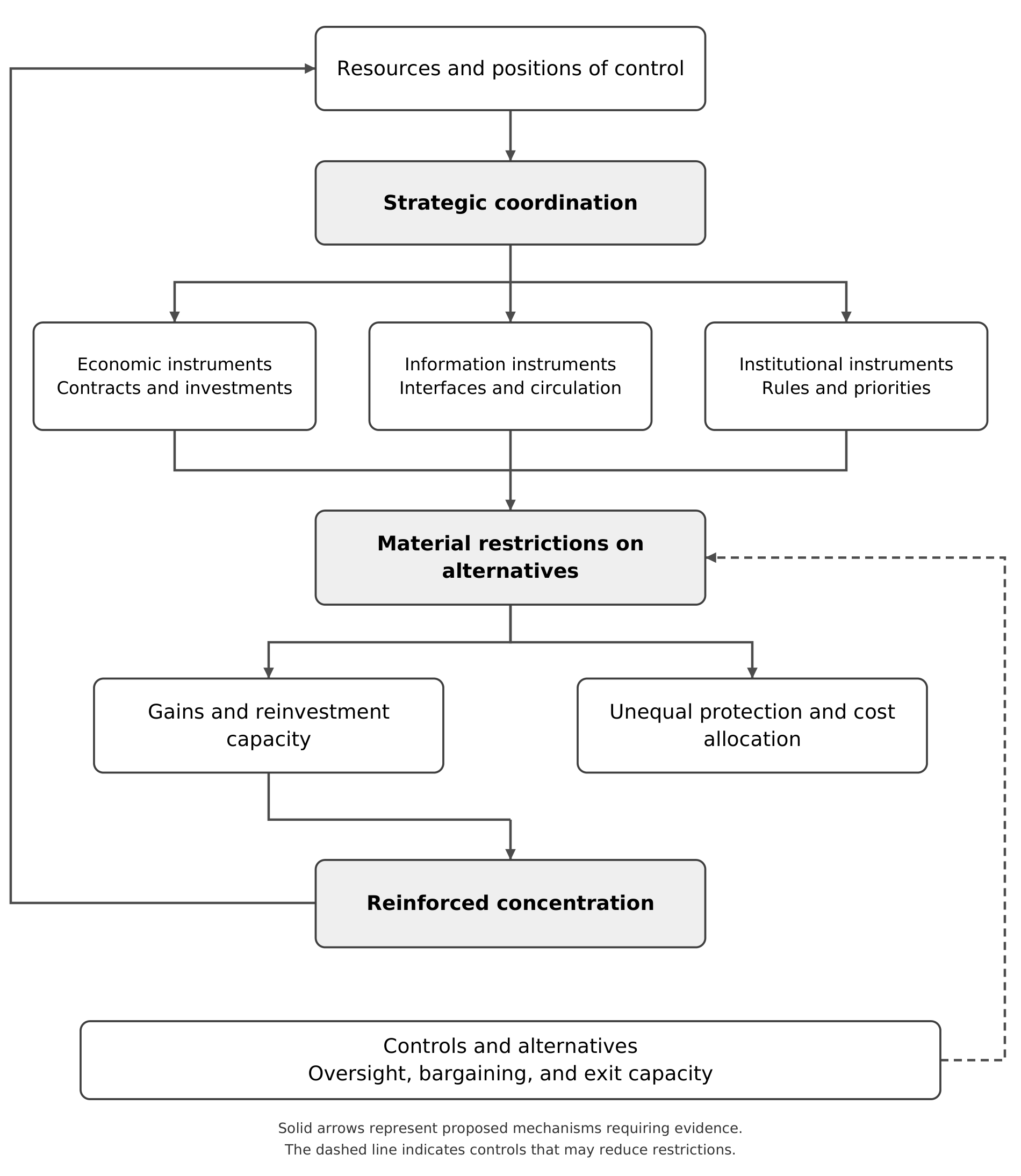
The cycle begins with control over capital, knowledge, infrastructure, and data. These resources finance strategies implemented through economic, informational, and institutional instruments. Contracts establish exclusivity and exit costs; interfaces distribute visibility; public decisions set incentives and oversight conditions.
Dependency intensifies when replacing a system requires money, knowledge, or time that the dependent party lacks. Refusal remains formally possible but materially difficult. Migration costs, timelines, and workable alternatives make that difference open to scrutiny.
Gains reinforce initial positions when they finance acquisitions, research, infrastructure, and influence over rules. Investment and innovation can produce social benefits; the problem arises when expansion also reduces the ability to challenge power and shifts costs to people least able to avoid them.
The distribution of protection and costs forms a separate branch of the analysis. Its feedback into accumulation requires a concrete link: for example, an expense shifted to the public budget preserves the beneficiary's resources and strengthens its position. Purchasing private protection alone does not establish this cycle.
Competition, collective bargaining, oversight, and technological alternatives can interrupt the reproduction of dependency. The flowchart identifies the proposed mechanisms and the points at which these interventions matter.
6 What the documents already establish
The Federal Trade Commission's January 2025 staff report examined the Microsoft–OpenAI, Amazon–Anthropic, and Google–Anthropic partnerships. Using documents submitted through September 2024 and public information through January 2025, it described financial and consultation or control rights, cloud spending commitments, and resource and information sharing. It identified potential effects on inputs and switching costs without determining that the arrangements were unlawful [5]. This is a documentary snapshot of that period.
In its July 2025 final report, the UK's Competition and Markets Authority (CMA) concluded that competition in UK cloud infrastructure markets was working less effectively than expected. It identified high concentration, switching barriers, and strong positions held by Microsoft and AWS [6, paras. 9.18–9.26]. There is therefore an official basis for investigating how dependency limits customers' ability to change providers.
The US AI Action Plan of July 2025 proposes technological leadership, infrastructure expansion, reductions in regulatory barriers, and exports of AI technology packages. Recommended actions include consortia linking government and industry for technology exports [7]. The document sets out a state strategy with international reach; its announcement must be distinguished from implementation.
These sources identify firms, commitments, and objectives. Technological accumulation involves organized decisions whose implementation mechanisms can be examined. Acemoglu and Robinson offer a theoretical model explaining how investments in de facto power can offset changes in formal political power [8]. Farrell and Newman show how central positions in international networks can enable information gathering and restrictions on access [9]. The task is to identify who holds those capacities in each arrangement and what controls apply to them.
7 Information circulation and political effects
Control over information distribution makes it possible to organize exposure and visibility. Translation into changes in belief and behavior depends on the audience, content, and duration of exposure. In Guess and colleagues' experiment during the 2020 US election, chronological feeds changed use and exposure on Facebook and Instagram. The study found no statistically significant changes in the main political attitudes measured over three months [10]. That result defines the observed effects without resolving other settings or time frames.
In Salvi and colleagues' preregistered randomized experiment with 900 participants, GPT-4 with access to personal data outperformed the human-versus-human baseline on a measure of agreement after controlled debates [11]. The September 2026 correction preserved that result and clarified that the direct comparison between personalized and nonpersonalized AI did not reach statistical significance [12]. The evidence identifies persuasive capacity in debates; electoral effects require their own investigation.
In Brazil, the relationship between political expression and livelihood prompted a concrete institutional response. On October 29, 2026, the Labor Prosecutor's Office (MPT) reported filing a lawsuit against Meta to remove posts encouraging workplace surveillance and discrimination based on voting choices, seeking R$50 million in damages for collective nonpecuniary harm. The office attributes the amplification of this content to recommendation systems [13].
According to an official report from the Regional Labor Court for the Second Region, the 77th Labor Court granted an interim injunction on October 29 requiring removal of the 14 identified URLs, an end to algorithmic boosting of that material, and a notice to users. Generic monitoring and preventive account deactivation requests were denied [14]. Damages remain a claim, and the injunction is provisional. This account relies on institutional communications rather than examination of the full case record or verification of compliance.
When expressing a conviction threatens a person's livelihood, political freedom carries a material cost. My article on electoral coercion and cognitive sovereignty examines this connection [15]. Protection must reach threatened individuals regardless of political preference and enable investigation of how threats circulate. The case also shows that public institutions can impose limits on platform power.
8 Historical continuity and the limits of analogy
Steam power, industrial production, and digital networks invite a common question: how does control over production and circulation become power over labor and public decisions? Historical comparison illuminates distributional conflicts and changes in the capacity for social organization.
The hypothesis of learning across authoritarian projects can be investigated through documents, the circulation of ideas, financing, and organizational links. A lineage extending back to the 1930s requires that reconstruction, just as applying categories such as fascism and Nazism requires their own historical criteria.
Threats to rights already warrant action when economic or state power supports persecution of minorities, workplace intimidation, or suppression of pluralism. Identifying the conduct, who finances it, and who is affected makes it possible to address concrete harm. The same standard must apply to corporations, governments, and groups of any orientation.
9 Environmental crisis and unequal protection
AI infrastructure depends on physical resources. In the base case of its 2025 Energy and AI report, the International Energy Agency (IEA) projected global data center electricity consumption rising from about 415 TWh in 2024 to approximately 945 TWh in 2030. The projection covers data centers generally, with AI as an important growth driver [16].
Expansion raises a distributional question: who receives the benefits and who bears the costs of connection, grid reinforcement, and environmental exposure? In A conta da infraestrutura computacional, I propose separating project-attributable expenses from investments with system-wide benefits and linking incentives to verifiable commitments [17]. Installed computing capacity must be assessed against public benefits and conditions for oversight.
The Intergovernmental Panel on Climate Change (IPCC) identifies mutually reinforcing relationships among inequality, vulnerability, and climate impacts, with disproportionate effects on marginalized groups [18]. In the third book, the hypothesis of privatizing continuity and socializing collapse examines wealth converted into exclusive protection and exit capacity, linked to influence over public priorities and the transfer of costs [4, pp. 163–165].
The decisive issue is the relationship between purchased protection and deteriorating shared services. An investigation follows budgets, priorities, and risk allocation to identify who remains exposed. When diminished economic centrality is linked to unjustified withdrawal of protection and reduced means of challenging decisions, the third book examines the treatment of people as an administered surplus population [4, pp. 81–83]. This category criticizes institutional classification: no person is surplus in dignity or rights.
10 Concentration scenarios and living conditions
I use ten and twenty years as comparison horizons for an accumulation simulation and a discussion of social risks. The calculation is a sensitivity exercise: it shows the effects of selected assumptions without predicting dates of rupture or measuring AI's causal impact.
I begin with 100 units of wealth: 75 for group A, the initially wealthiest 10%, and 25 for B, the remaining 90%, approximating the global distribution presented in the inequality report [1]. Group membership stays fixed. I multiply each group's initial wealth by its compounded annual growth factor and divide the result by total wealth at the end of the period. The hypothetical rates represent real, net wealth growth, already incorporating consumption, taxes, and transfers. The exercise does not model movement between groups, demographics, crises, or macroeconomic responses. A is not restricted to billionaires or technology companies.
| Illustrative scenario | Rates A / B | A at 10 years | A at 20 years |
|---|---|---|---|
| Persistent advantage | 5% / 2% | 80.0% | 84.3% |
| Faster concentration | 7% / 1% | 84.2% | 90.5% |
| Broader distribution | 2% / 4% | 71.2% | 67.0% |
Source: the author's illustrative calculation. Annual real growth rates are hypothetical. The final two columns show A's share of total wealth; its initial share is 75% in every scenario. Results are rounded to one decimal place.
Under persistent advantage, A reaches 84.3% in twenty years even as B's aggregate wealth grows in real terms. Under faster concentration, A reaches 90.5%; when B grows more rapidly, it falls to 67.0%. The growth differential and elapsed time alter distribution. Effects on wages, prices, and political power depend on institutional mechanisms.
Over a ten-year horizon, concentrated gains, weaker bargaining power, and costs shifted to the public can increase material insecurity, especially if productivity rises without proportionate improvements in pay, time off, and services. In 2025, the International Labour Organization (ILO) estimated that one in four workers held an occupation with some degree of exposure to generative AI. It identified task transformation as more likely than the elimination of most jobs [19]. Exposure does not measure layoffs; the issue also concerns who controls the reorganization of jobs that continue to exist.
Over a twenty-year horizon, if these conditions persist, wealth and access could increasingly determine who obtains safe housing, healthcare, reliable energy, and quality education. Deteriorating fiscal capacity and shared services, alongside expanding private protection, could turn economic inequality into inequality in the ability to survive. This is a conditional projection of the relationships discussed, distinct from the arithmetic result.
The human scale already reaches billions: in its 2023 synthesis, the IPCC reported approximately 3.3 to 3.6 billion people living in contexts highly vulnerable to climate change [20, A.2.2]. This figure describes climate vulnerability, not AI-attributable harm. Overlapping economic insecurity, restricted services, and environmental risks can increase illness, displacement, and preventable deaths. Protecting these populations is a matter of rights regardless of their profitability.
Workers sharing in gains, universal services, progressive taxation, and effective competition offer paths toward broader distribution. The third scenario illustrates relatively more favorable accumulation for B without estimating these policies' effects. Monitoring must compare wealth distribution, compensation, public burdens, and access to protection. These outcomes provide a basis for holding institutions accountable rather than treating concentration as a technological destiny.
11 A hypothetical example in an essential service
Consider a fictional public service network that procures AI to organize access to an essential service. The contract offers favorable initial prices, integration with proprietary tools, and records that are difficult to migrate. Over time, staff depend on automated recommendations and lose the ability to reconstruct decisions without the vendor.
Integration may meet security or performance needs. The problem arises when the institution loses the means to audit criteria, correct exclusions, maintain continuity, or replace the service. Contracts, permissions, records, and contingency tests help distinguish controlled integration from dependency without a workable exit.
If disagreeing with a recommendation means delaying a queue, having to justify the decision alone, or jeopardizing a performance review, confirming the output becomes more convenient than reviewing it. My article on the asymmetry in the costs of divergence examines this incentive [21]. The proposed protection covers reasoned disagreement and diligent review, with scrutiny of mistaken acceptance as well.
The example connects an individual decision, returns generated by dependency, and loss of control over a public function. In an actual application, a finding of capture would require the conditions in Section 4 to be established jointly within the same arrangement and period.
12 A framework for investigation and action
Begin with a defined operation: a decision, an infrastructure, an affected group, and a period. Identify who controls the operation and fill in the matrix using documents, observable effects, and alternatives. It organizes the investigation without replacing legal assessment of the case.
| Dimension | Investigative question | Evidence to seek |
|---|---|---|
| Control | Who can change objectives and access conditions? | Contracts, decision rights, and technical permissions |
| Coordination | What commitments connect the actors? | Clauses, joint plans, and lawfully obtained communications |
| Dependency | How much does refusal or exit cost? | Migration costs and timelines, tests, and workable alternatives |
| Gains and costs | Who receives returns and bears consequences? | Revenue, public incentives, allocated expenses, and impact records |
| Challenge | Who can understand and correct a decision? | Records, appeals, deadlines, and effective interventions |
| Counterevidence | What weakens the initial hypothesis? | Viable competition, effective controls, and divergent outcomes |
For an initial application, I propose a thirty-day cycle. In week one, the person responsible defines the operation and gathers public or lawfully accessible documents. In week two, that person maps beneficiaries, cost bearers, and available alternatives. In week three, they request clarification of gaps and record the responses. In week four, they present a decision memo identifying actions, responsible parties, and deadlines. The cycle organizes initial screening; complex investigations and operational tests may require more time.
The memo must connect each conclusion to its source and distinguish documented fact, allegation, risk, and hypothesis. An information gap should generate an identified question or investigative step. Its evidentiary consequences depend on applicable rules, including relevant presumptions. Access, preservation, and disclosure of records must respect purpose, data protection, and legitimate confidentiality restrictions.
The useful outcome is a verifiable decision: require information, renegotiate a term, test an exit, correct a procedure, or refer the matter to the appropriate authority. Each action needs an accountable person and a way to verify completion. Independent researchers can apply the documentary component to published contracts, reports, and decisions without conducting original experiments.
13 Legal responses and governance proposals
In Brazil, Article 170 of the Constitution grounds the economic order in the value of human labor and free enterprise, with the aim of ensuring a dignified existence consistent with social justice. Its principles include consumer protection, free competition, and reduced inequality [22]. These foundations guide the selection of responses, whose application requires appropriate authority, procedure, and legal basis.
Article 20 of Brazil's General Data Protection Law (LGPD) entitles individuals to request review of decisions based solely on automated processing of personal data that affects their interests. Paragraph 1 requires the controller to provide, when requested, clear and adequate information on criteria and procedures, subject to trade and industrial secrecy. If information is withheld on secrecy grounds, paragraph 2 permits the national authority to conduct an audit for discriminatory aspects [23]. The provision does not expressly establish a general guarantee of review by a natural person.
In the European Union, Articles 34 and 35 of the Digital Services Act require providers of very large online platforms and search engines covered by the regime to assess and mitigate systemic risks [24]. This comparative reference shows how duties can reach service design and operation. Similar measures in Brazil need their own legal basis and must protect freedom of expression.
As a governance proposal, I recommend incorporating an exit plan into essential infrastructure procurement: export formats, access to records, responsible parties, costs, and continuity during transition. Risk-proportionate tests should produce records of feasibility, migration timelines, and responses to failures. Implementation requires instruments consistent with the contract, security, data protection, and sector-specific rules.
Audits need independence, a defined scope, and sufficient access. Behavioral testing helps identify observable patterns, including where code is proprietary, but its ability to establish safety, causation, and compliance depends on evaluation design and scope. Human oversight needs information, time, and authority to correct the outcome.
In industrial policy, public incentives should be assessed against training, research, workable alternatives, and verifiable benefits. Domestic AI production should be accompanied by the capacity to oversee and replace systems, pluralism, and safeguards for affected people. Sovereignty requires the means to exercise control over essential functions.
14 What could support or weaken the model
An investigation gains strength when it reconstructs objectives preceding an outcome, implementation instruments, restricted alternatives, and reinvestment of gains. Comparisons between changes in instruments and outcomes must consider other explanations. A temporal sequence or documented component does not, by itself, establish the complete cycle.
Alternatives actually used, lower exit costs, controls capable of imposing corrections, and broader distribution of gains can weaken the hypothesis within the arrangement under review. Conflicts among firms and states are also part of the explanation. Revising the hypothesis in response to these findings is part of the method.
Independent research can compare published cases, maintain a consistent unit of analysis, and track institutional responses. Recording the source, date, conclusion, and limitations makes it possible to build knowledge and identify which measures actually reduce dependency.
15 Conclusion
Wealth concentration becomes power over life when it enables control of essential infrastructure and the imposition of conditions that affected people have little capacity to challenge. In the AI economy, contracts, system design, and public decisions can reinforce this asymmetry. The instruments and responsible actors must be identified so that democratic oversight reaches the exercise of power.
Decisional autonomy, the monetization of vulnerability, and captured sovereignty connect three questions: how choice is organized, who earns returns from that organization, and when an institution loses the ability to correct it. This article offers a framework for examining that transition and turning a diagnosis into verifiable action.
Concentrated gains accompanied by costs shifted to the public can produce a society that is technically more capable and materially less secure for many of its members. The gravest risk is wealth converted into the power to set the conditions that sustain other people's lives. Human dignity requires that protection and the means of living do not depend on each person's profitability.
The practical priority is to preserve workable alternatives, shared services, and institutions able to restrain abuse and distribute the benefits of technological progress. AI's public value must also be judged by who can correct its effects and who is relieved of costs they never had a say in imposing.
References
- CHANCEL, Lucas; GÓMEZ-CARRERA, Ricardo; MOSHRIF, Rowaida; PIKETTY, Thomas (coordinators). World Inequality Report 2026: executive summary. Paris: World Inequality Lab, 2025. pp. 4–6. Online source
- GENOVA, Jandislei Antonio. Autonomia decisória na era da IA: formação da vontade, influência cognitiva estrutural e responsabilidade jurídica em ambientes algorítmicos. São Paulo: Editora Dialética, 2026. 156 p. ISBN 978-65-288-0467-2.
- GENOVA, Jandislei Antonio. A monetização da vulnerabilidade: plataformas digitais, vício, ódio e responsabilidade civil na era algorítmica. São Paulo: Editora Dialética, 2026. 168 p. ISBN 978-65-288-1381-0.
- GENOVA, Jandislei Antonio. A soberania capturada: Big Techs, soberania cognitiva e poder privado na ordem digital global. São Paulo: Author edition, GENOVA imprint, 2026. Version 8.20. 323 p. ISBN 978-65-02-43592-2. DOI 10.5281/zenodo.23272360. Online source
- FEDERAL TRADE COMMISSION. Partnerships Between Cloud Service Providers and AI Developers: FTC Staff Report on AI Partnerships & Investments 6(b) Study. Washington, DC: Office of Technology Staff, January 2025. Sections 1, 4, and 5. Online source
- COMPETITION AND MARKETS AUTHORITY. Cloud Infrastructure Services: Final Decision Report. London: CMA, July 31, 2025. Summary and Chapter 9, especially paragraphs 9.18–9.47. Online source
- THE WHITE HOUSE. Winning the Race: America's AI Action Plan. Washington, DC, July 2025. Introduction and Pillars I through III. Online source
- ACEMOGLU, Daron; ROBINSON, James A. Persistence of Power, Elites, and Institutions. American Economic Review, vol. 98, no. 1, pp. 267–293, 2008. DOI 10.1257/aer.98.1.267. Online source
- FARRELL, Henry; NEWMAN, Abraham L. Weaponized Interdependence: How Global Economic Networks Shape State Coercion. International Security, vol. 44, no. 1, pp. 42–79, 2019. DOI 10.1162/isec_a_00351. Online source
- GUESS, Andrew M. et al. How do social media feed algorithms affect attitudes and behavior in an election campaign? Science, vol. 381, no. 6656, pp. 398–404, 2023. DOI 10.1126/science.abp9364. Online source
- SALVI, Francesco; HORTA RIBEIRO, Manoel; GALLOTTI, Riccardo; WEST, Robert. On the conversational persuasiveness of GPT-4. Nature Human Behaviour, vol. 9, pp. 1645–1653, 2025. DOI 10.1038/s41562-025-02194-6. Read with the correction in reference 12. Online source
- SALVI, Francesco; HORTA RIBEIRO, Manoel; GALLOTTI, Riccardo; WEST, Robert. Author Correction: On the conversational persuasiveness of GPT-4. Nature Human Behaviour, vol. 10, p. 2047, 2026. Published online September 3, 2026. DOI 10.1038/s41562-026-02588-0. Online source
- MINISTÉRIO PÚBLICO DO TRABALHO. MPT processa Meta em R$ 50 milhões e quer remoção imediata de conteúdos de assédio eleitoral. Institutional statement, October 29, 2026. Case 1001837-49.2026.5.02.0077. Online source
- TRIBUNAL REGIONAL DO TRABALHO DA 2ª REGIÃO. Justiça do Trabalho de São Paulo determina que Meta remova conteúdos de suas redes que incentivem assédio eleitoral contra trabalhadores. Institutional report, October 29, 2026. Case ACPCiv 1001837-49.2026.5.02.0077. Online source
- GENOVA, Jandislei Antonio. Coerção eleitoral nas plataformas digitais e soberania cognitiva: da vulnerabilidade econômica à responsabilidade pelo poder de circulação. Version 1.3. October 30, 2026. Electronically signed PDF. Online source
- INTERNATIONAL ENERGY AGENCY. Energy and AI. Paris: IEA, 2025. Executive summary. Online source
- GENOVA, Jandislei Antonio. A conta da infraestrutura computacional: data centers, custos de rede e soberania regulatória no Brasil. Version 4.1. August 23, 2026. Online source
- INTERGOVERNMENTAL PANEL ON CLIMATE CHANGE. Climate Change 2022: Impacts, Adaptation and Vulnerability. Working Group II contribution to the Sixth Assessment Report. Chapter 8: Poverty, Livelihoods and Sustainable Development. Executive summary. Cambridge: Cambridge University Press, 2022. Online source
- INTERNATIONAL LABOUR ORGANIZATION. Generative AI and Jobs: A 2025 Update. Research brief. Geneva: ILO, May 20, 2025. Online source
- INTERGOVERNMENTAL PANEL ON CLIMATE CHANGE. Climate Change 2023: Synthesis Report. Summary for Policymakers, A.2.2 and C.5.3. Geneva: IPCC, 2023. Online source
- GENOVA, Jandislei Antonio. Quem paga por contrariar a inteligência artificial? A assimetria institucional dos custos da divergência algorítmica — da divergência protegida à distribuição jurídica dos custos da supervisão. Version 1.1. August 22, 2026. Online source
- BRASIL. Constituição da República Federativa do Brasil de 1988. Article 170. Online source
- BRASIL. Lei nº 13.709, de 14 de agosto de 2018. Lei Geral de Proteção de Dados Pessoais. Article 20 and paragraphs 1–2, as amended by Law No. 13,853/2019. Updated text published by the Chamber of Deputies. Online source
- UNIÃO EUROPEIA. Regulamento (UE) 2022/2065, de 19 de outubro de 2022. Digital Services Act. Articles 34 and 35. Online source
About the author
Jandislei Antonio Genova is an attorney, author, and independent researcher. His legal research addresses decisional autonomy, structural cognitive influence, vulnerability, and sovereignty in algorithmic environments. He is the author of Autonomia decisória na era da IA and A monetização da vulnerabilidade, published by Editora Dialética, and A soberania capturada, published under the GENOVA imprint. Website: https://jandisleigenova.com.
Independent essay by the author, not peer reviewed.