Private Digital Infrastructure and the Test of Sovereignty
Evidence from Starlink and X in Ukraine, Brazil, and the United States
Jandislei Antonio Genova
GENOVA imprint
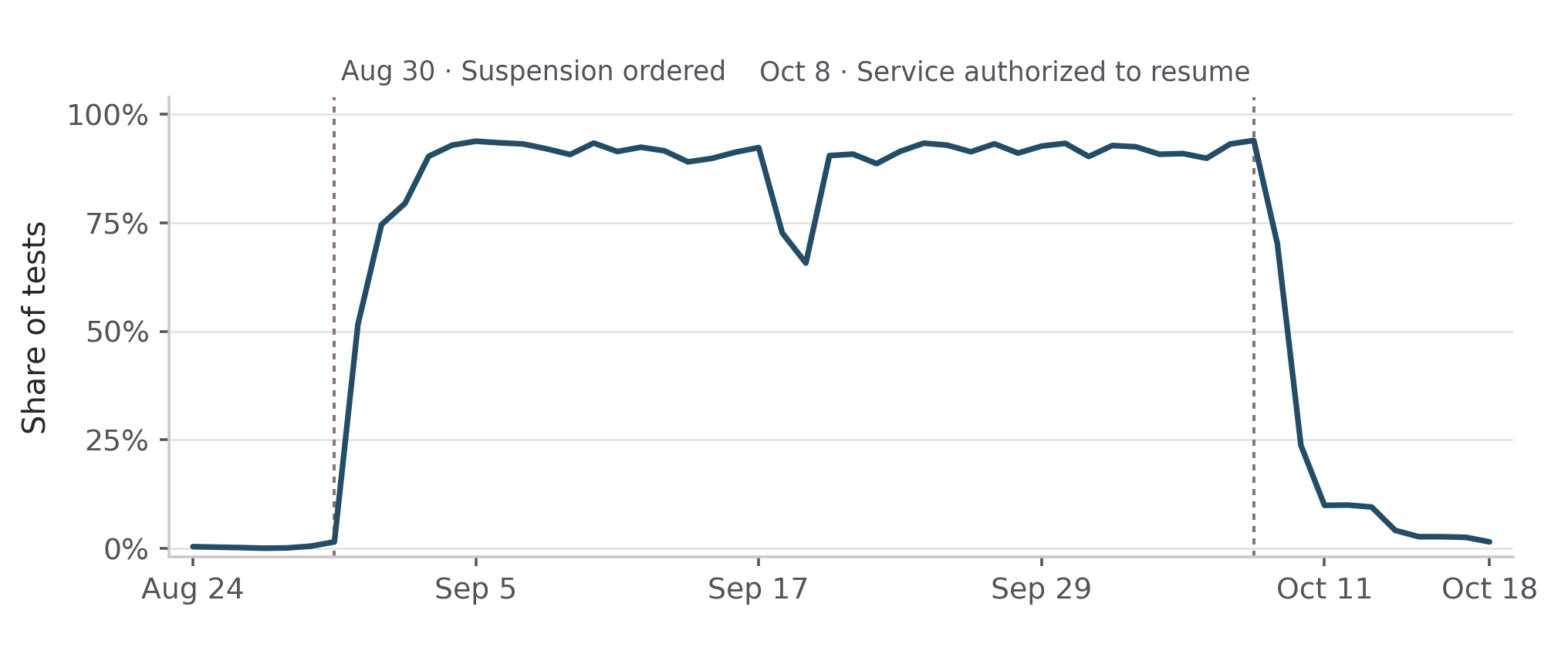
From August 31 through September 6, 2024, OONI recorded anomalous results in 82.50% of its 11,294 tests of access to twitter.com in Brazil. Download the share image (JPG)
Abstract
When does private control of infrastructure affect a public function or shape public opinion, and what evidence would justify a finding of capture? This article applies the test proposed in Captured Sovereignty to four cases: Starlink connectivity in Kherson, the court-ordered suspension of X in Brazil, internet access in rural schools in Manaus, and an experiment on X’s recommender system in the United States. The analysis draws on documentary sources, published studies, and a descriptive reanalysis of 84,238 tests of access to twitter.com in Brazil. Anomalous results accounted for 0.38% of tests in the week preceding the first persistent signs of blocking, 82.50% in the first week of blocking, and 4.47% in the week after access was observed to have resumed. The cases reveal differences in both corporate power and the ability of public institutions to respond. None of the four cases meets all the evidentiary requirements for a finding of capture. The findings clarify the scope of the thesis and identify the evidence still needed in the case that comes closest to meeting the test.
Keywords: cognitive sovereignty, digital infrastructure, private power, Starlink, platform regulation.
1 Introduction
Who decides whether emergency communications remain available when the public authority that bears responsibility for the consequences relies on a provider that can interrupt the service? In Ukraine, answering that question required reconstructing a wartime outage. In Brazil, a court order generated administrative and technical records that make it possible to assess how far the state could enforce its decision. The two episodes illuminate different aspects of the same question and leave room for opposite answers. [1, 6–12]
This article examines the ability to make a decision and enforce it in time for it to matter. I investigate three testable propositions. Corporate integration brings computing and distribution under common control. An operator can constrain access to essential communications. Algorithmic recommendations can influence attitudes. Corporate filings can establish the first proposition. The other two require evidence of who made a decision, what changed for those affected, and what means of challenge or substitution were available.
2 Methods and standards of evidence
This comparative study combines documentary analysis with descriptive reanalysis of public data. The review, completed on November 23, 2026, retrospectively selected four cases with an identifiable function, a defined period, and an observable outcome. Purposive selection allows competing interpretations of known events to be tested. Corporate developments in 2025 and 2026 provide later context and cannot retrospectively explain the events of 2022–2024.
The test developed in Captured Sovereignty requires four cumulative criteria and evidence of an actual loss of institutional control in the same setting and period. I classify the evidence for each criterion as established (E), partially established (P), or not established (NE). NE denotes insufficient evidence. A finding of capture requires a further judgment. Page citations to the book refer to the Portuguese edition. The U.S. edition has separate pagination. [1, pp. 20, 127, 211, 284–287; 29]
Criteria for assessing capture
Criterion
Question asked of the evidence
Functional indispensability
Which specific function would fail to operate within the required time without this service?
Asymmetric control
Who could change access or set operating conditions? Who depended on that decision?
Opacity, limited reversibility, or no viable alternative
Could the public authority determine what happened, reverse the change, or put a viable alternative into operation?
Material impact
What material consequence of private conduct was observed for rights, public decision-making, collective opinion formation, or essential functions?
Formal authority alone cannot settle the question. I look for a decision that took effect, a technical record of access, an observed interruption, or a measured change in attitudes. Court records establish obligations and procedural outcomes. Network measurements record availability. An experiment estimates the effect of randomly assigned exposure. These sources can corroborate one another only within the limits of what each measures.
One competing explanation runs through the comparison. A provider can expand the state’s capacity while retaining the power to constrain it on another occasion. To distinguish the two, the evidence must show who had an alternative at the time and how long it would have taken to put it into service.
3 Corporate integration and control over a function
A filing with the U.S. Securities and Exchange Commission documents the sequence of acquisitions. On March 28, 2025, xAI acquired X’s parent company. SpaceX completed its acquisition of xAI on February 2, 2026, and of Cursor, a developer of programming tools, on August 14. SpaceX described the Cursor acquisition as part of its strategy to integrate computing infrastructure, models, and applications. The filing documents a publicly stated business objective. It offers no evidence of intent to control a particular government decision. [4, note 1 and Acquisitions section]
Starlink’s subscriber base also grew. SpaceX reported 7.2 million service lines in its consumer subscriber category in September 2025 and 13.6 million a year later. The rounded figures imply an increase of 6.4 million lines, or about 89%. A single line may serve several people, and the metric excludes certain directly negotiated contracts. This growth measures service adoption. Market share, the number of physical installations, and the alternatives available at a particular site each require separate evidence. [4, Connectivity section]
Plantin and colleagues explain how a platform takes on the characteristics of infrastructure as other activities come to depend on it. In his study of Starlink in Ukraine, Abels shows how corporate decisions interact with government policy and the economic conditions under which a service is supplied. Read together, these studies guard against a common error of attribution. Economic concentration creates an opportunity to exercise power. Evidence of a specific exercise of that power must come from the episode in question. [2–3]
It is also possible to document an ambition before it becomes an operating capability. In January 2026, a SpaceX company applied to the U.S. Federal Communications Commission for authority to launch and operate up to one million satellites for computing in Earth orbit. The application identifies the proposed scale and the regulator to which it was submitted. It does not establish the capacity actually deployed or a political motive on Elon Musk’s part. The same limit on attribution applies to all four cases. [1, pp. 20, 113–115; 26]
4 Ukraine and the power to interrupt communications
After Russia’s full-scale invasion in February 2022, the Ukrainian government received Starlink terminals from several sources. The Office of Inspector General of the U.S. Agency for International Development (USAID) documented the delivery of 5,175 terminals intended to provide connectivity and support critical civilian services. The agency did not track where the terminals went or how they were used after transfer. The inspection establishes delivery and intended use. It neither measures the benefit to individual services nor identifies which terminals lost coverage in the Kherson region. [5]
On October 7, 2022, the Financial Times reported accounts from Ukrainian officials and soldiers who had lost connectivity as Ukrainian forces retook territory. The paper also reported that some terminals were working in areas where other sources reported outages. The geographic variation matters. Contemporaneous accounts support the occurrence of interruptions with operational consequences while ruling out an inference that the entire territory lost coverage at once. [6]
In July 2025, Reuters attributed an order to cut coverage in areas including the Kherson region to Elon Musk, citing three people familiar with the episode. According to the investigation, at least 100 terminals were deactivated in late September 2022, and Ukrainian officials struggled to obtain an explanation. SpaceX disputed the accuracy of the reporting without identifying a specific error. Musk did not respond to the news agency’s requests for comment. The precise date, duration, and motive remain uncertain. The earlier Financial Times report corroborates outages but does not identify who gave the order. [6–7]
The evidence supports a finding of a localized operational constraint. Reuters also reported that Ukraine ultimately retook Beryslav and the city of Kherson. The outages do not establish that the provider determined the outcome of the campaign. A finding of capture would require evidence that the responsible authority actually lost the ability to maintain communications within the critical window. Contemporaneous records of continuity and restoration could establish that loss or show that it was overcome in time. [1, pp. 127, 211; 3; 7]
5 Brazil and the power to enforce a court order
On August 30, 2024, Justice Alexandre de Moraes ordered the suspension of X in Brazil in proceedings concerning the platform’s failure to comply with court orders and its lack of a legal representative in the country. On September 2, the First Panel of Brazil’s Federal Supreme Court (STF) unanimously upheld the suspension. Justice Luiz Fux qualified his concurrence regarding the order’s reach over third parties. The empirical question is narrow. Could the public authority make the platform’s continued operation contingent on compliance with its requirements? [8–9]
On September 5, the Brazilian news outlet UOL reported, citing a filing by the National Telecommunications Agency (Anatel), that Starlink had blocked access to X on its network the previous day. The order concerned the platform and did not suspend schools’ internet connections. On September 18, Anatel informed the court that X had again become accessible on some networks. The next day, the presiding justice ordered additional measures and imposed a fine. Enforcement encountered resistance, and its eventual effectiveness had to be demonstrated. [9–10, 28]
On October 8, after X appointed a legal representative, blocked specified accounts, and paid the fines, the justice overseeing the case authorized the platform to resume operations. On October 9, Anatel began notifying providers to restore access and explained that each would have to implement the change on its own network. The first date marks judicial authorization and the second the start of administrative implementation. Whether users could reach the platform requires independent observation. [9, 11]
The Open Observatory of Network Interference (OONI), an independent monitoring organization, documented persistent signs of blocking beginning on August 31 across more than 25 networks tested. Its report places the observed return of access on October 11 and links to the aggregated measurements. The court ruling, the company’s compliance, and the network tests support a limited finding. In this episode, Brazil retained effective means to set conditions on X’s operation. Enforcement also temporarily restricted users’ access. The connectivity series cannot establish whether the restriction was legally proportionate or how much the state knew about the platform’s recommender system. [8–12]
6 What the Brazilian network measurements show
I retrieved daily Web Connectivity counts from the public API of the Open Observatory of Network Interference (OONI) for the legacy domain twitter.com in Brazil from August 24 to October 18, 2024 (UTC). The series comprises 84,238 measurements over 56 days. For each retrospectively selected seven-day window, I divided anomalous measurements by all tests, including failed tests. The first window ends on the date of the court order. The second begins on the first day of persistent signs of blocking. The last begins the day after OONI observed access returning. [12–14]
Anomalous tests of access to twitter.com in Brazil
2024 window
Anomalous tests
Total tests
Share
August 24–30
38
9,977
0.38%
August 31–September 6
9,317
11,294
82.50%
October 12–18
444
9,925
4.47%
The increase between the first two weeks was 82.11 percentage points before rounding. Excluding failed tests yields 0.38%, 86.12%, and 4.48%. The final week remained above baseline. The percentages describe results from volunteer probes, which may run repeated tests. No measurement met OONI’s automated criteria for a confirmed block. Without a recognized technical signature, an anomaly can have other causes. The interpretation here draws on the series, court orders, and records of enforcement. [8–14]
7 The scope of the Brazilian evidence
Because twitter.com already redirected to x.com, I repeated the query for the primary domain. Across the same three windows, anomalous tests for x.com numbered 0 of 657 (0.00%), 730 of 876 (83.33%), and 20 of 605 (3.31%). Both domains show the same direction of change. They may share probes and access paths, so their counts should not be pooled. For www.wikipedia.org, a domain outside the order, there were zero anomalies in 197, 232, and 226 tests, respectively. Networks were not matched across domains, volumes differed, and no domain measures the full availability of the app. [12–14, 20, 24–25]
Filtering the same database by Starlink’s network identifier (AS14593) yielded three tests without anomalies on August 31 and no records for the next three days. All 45 tests recorded on that network from September 4 through 6 were anomalous, with 15, 10, and 20 tests on the respective days. The results are consistent with restricted access to the domain during that interval. The small counts and gaps prevent an estimate of the time of implementation or the proportion of customers affected. These tests are already included in the Brazilian totals. [10, 13–14, 21–22]
School internet access in Manaus
In Semed Manaus em Revista, the Manaus Municipal Department of Education reported that all 75 rural schools in the municipal system, serving communities along rivers and roads, had received Starlink connectivity. The publication identifies the school system and the scope of the rollout. It does not provide school-level uptime measurements, backup contracts, or provider-switching times. The documented fact is the department’s report of adoption. Whether the municipality lost the capacity to keep school activities running remains unestablished. [15, p. 24]
A separate example clarifies the geographic limits of that finding. In January 2025, the state-owned telecommunications company Telebras reported maintaining 26 satellite antennas to support health services in Yanomami territory, including at the Surucucu, Auaris, and Missão Catrimani health posts. The installations document an operating public option for a specific health service. They do not establish the time, capacity, or cost required to serve the schools in Manaus. A backup-service test at each school would answer that question more directly than a national list of providers. [15–16]
8 Political influence on X in the United States
X’s algorithmic feed selects and ranks posts from accounts the user follows as well as from other accounts. Switching tabs thus changes both which posts the reader sees and the order in which they appear. Captured Sovereignty asks whether such a change can affect measurable attitudes. Answering that question requires a design that distinguishes the effect of the feed from the preferences that initially drew users to a particular information environment. [1, pp. 42–43]
Gauthier, Hodler, Widmer, and Zhuravskaya addressed part of this problem in a field experiment with active X users in the United States. Between July and September 2023, members of a volunteer panel were randomly assigned to use an algorithmic or a chronological feed for about seven weeks. Of the 6,043 participants who completed the baseline survey, 4,965 completed the follow-up. The comparison took account of participants’ initial feed settings. About 24% initially used the chronological feed. Attrition and volunteer recruitment limit generalization. They have made anonymized data and replication protocols available. [17–18]
Among users who had been using the chronological feed, assignment to the algorithmic feed shifted a composite index of views on public policy and current events by 0.12 standard deviations in a more conservative direction, relative to assignment to remain on the chronological feed (95% CI, 0.04 to 0.21, p = 0.004). This is a standardized difference on an index. It cannot be interpreted as a 12% change in the electorate, vote share, or ideological affiliation. The researchers detected no statistically significant change in party identification or affective polarization. [17]
The switch in the opposite direction had no comparable political effect among participants who had started with the algorithmic feed. These were distinct groups at baseline. An earlier study, conducted before Musk acquired the platform, found that in six of seven countries the algorithm amplified posts by legislators on the mainstream right more than posts by legislators on the mainstream left. The earlier study measured exposure. The later experiment also measured attitudes. Neither study attributes its findings to a personal directive, measures Brazilian votes, or documents an electoral authority’s loss of control. [17, 19]
9 Comparing the findings
The table summarizes my assessment of the evidence. Each of the four middle columns addresses a distinct criterion. Establishing a loss of institutional control requires a further inference from the evidence taken together. The last column identifies what the sources establish even where capture remains unproven. The criteria must be supported within the same case. An effect observed in one country cannot fill a gap in the evidence from another. [1, pp. 284–287]
Assessment of the four cases
Function and setting
Service essential
Asymmetric control
Opacity or limited reversibility
Impact of private conduct
Observed outcome
Communications in the Kherson region, 2022
P
E
P
E
Operational constraint
Enforcement of the X order in Brazil, 2024
NE
P
NE
P
Suspension lifted following compliance
Continuity of schooling in Manaus, 2024
NE
NE
NE
NE
Connection adopted in 75 schools
Opinion formation on X in the United States, 2023
NE
E
NE
P
Influence on specific attitudes
E = established. P = partially established. NE = not established. The first criterion asks whether that particular service was indispensable within the relevant time window. X controlled the makeup of the U.S. algorithmic feed, although users could choose another tab. Brazil’s court-ordered restriction of access is established. The P rating refers solely to the effect of company conduct on enforcement. [5–22, 24, 28]
In the Kherson region, the sources support an operational asymmetry and a material disruption of communications. Attribution of the order to a specific individual rests on Reuters’ investigation, which the company disputed. In Brazil, the temporary restoration of access in September and the ensuing court action document an enforcement difficulty. The scale and institutional cost of that private conduct remain uncertain. In Manaus, adoption does not establish the provider’s indispensability. In the United States, the effect on attitudes is established for the subgroup studied. Its consequences for collective decisions remain only partially supported.
Selecting cases connected to the same business figure favors publicly visible episodes. The author who proposed the test also coded the cases, without a second independent coder. This comparison therefore does not estimate prevalence, agreement between coders, or performance against a benchmark of cases classified by others.
10 What evidence would challenge the findings?
Does common corporate ownership establish capture of a public function?
The 2026 records document common ownership, subscriber growth, and orbital projects. Explaining a state decision requires an evidentiary link between the asset and the specific exercise of power. In Brazil, the relationship can be traced in the other direction: a public authority issued an order, enforcement encountered obstacles, and X resumed operations after meeting the conditions. Public oversight was exercised over that function. The order says nothing about the state’s ability to audit how X selects content. [4, 8–14, 26, 28]
Can the test distinguish cases in which the technology was decisive?
An earlier comparison from the book, outside this article’s four cases, comes from Hamilton and others v Post Office Limited. In 2021, the Court of Appeal of England and Wales quashed 39 criminal convictions in cases where the prosecution depended on the reliability of records produced by the Horizon accounting system. The defendants lacked adequate access to evidence with which to challenge those records. In three other appeals the system’s reliability was not essential to the prosecution, and the convictions stood. In Captured Sovereignty, I interpret the first group as an instance of functional capture of the evidentiary process. The court established the facts and ruled on the appeals. The classification is my own. [1, pp. 285–286; 27]
What would change the conclusion about Kherson?
Evidence that a workable alternative was available in time would weaken the claim of indispensability. Proof that no substitute existed would strengthen that criterion, but the outage would still have to be linked to an actual loss of public capacity for the specific function. This standard recognizes the human stakes of a communications failure while keeping the attribution of responsibility for an entire operation or war within the bounds of the evidence. [1, p. 211; 6–7]
11 Conclusion
The opening question yields different answers for services under the influence of the same business figure. In Kherson, the reporting supports the interpretation that a provider decision narrowed the options available to public authorities during an operation. The company disputes that account. In Brazil, documents and network measurements trace the exercise of authority in the other direction. A public authority set conditions for a platform to operate, and access resumed after the requirements were met. Concentration of corporate ownership helps explain why both cases matter. It does not predict their outcomes.
The Manaus case shows what can be missed by equating a provider’s market presence with a loss of sovereignty. For teachers and students at a riverside school, internet access can expand the ability to exercise the right to education. Dependence becomes a concern when continued access rests on terms school administrators cannot ascertain or arrangements they cannot replace. The adoption record is a starting point. To assess continuity, researchers also need the contract, evidence about local conditions, and, above all, a tested recovery time.
The US experiment has a different implication. A change in which posts appeared and how they were ranked altered some political opinions without a detectable change in party identification. This supplies empirical grounds for examining how platforms structure the environment in which political choices are made. A claim of capture in a specific election would require further evidence that a public authority or community had lost the practical ability to understand, challenge, or correct the mechanism and that this loss materially impaired the relevant function.
These findings clarify the scope of the argument in Captured Sovereignty. There is evidence of political influence and of an operational constraint. Across the four cases, the evidence does not establish functional capture. Kherson offers the clearest opportunity to revise that conclusion. Contemporaneous records showing that a substitute was available and activated in time would weaken the case for loss of control. Records showing that the authorities could not determine what had happened, challenge the decision, or switch providers during the critical interval would strengthen it. A test of sovereignty is more useful when it identifies the evidence that could show public control was preserved as well as the evidence that could show it was lost.
Research articles, documentary sources, and database queries. Accessed November 23, 2026.
[1] GENOVA, Jandislei Antonio. A soberania capturada: Big Techs, soberania cognitiva e poder privado na ordem digital global. 1st ed., version 8.20. São Paulo: Author’s Edition, GENOVA imprint, 2026. 323 pp. Page references are to the Portuguese edition. DOI 10.5281/zenodo.23272360
[2] PLANTIN, Jean-Christophe; LAGOZE, Carl; EDWARDS, Paul N.; SANDVIG, Christian. Infrastructure studies meet platform studies in the age of Google and Facebook. New Media & Society, vol. 20, no. 1, pp. 293–310, 2018. DOI 10.1177/1461444816661553
[3] ABELS, Joscha. Private infrastructure in geopolitical conflicts: the case of Starlink and the war in Ukraine. European Journal of International Relations, vol. 30, no. 4, pp. 842–866, 2024. DOI 10.1177/13540661241260653
[4] SPACE EXPLORATION TECHNOLOGIES CORP. Quarterly report on Form 10-Q for the quarterly period ended September 30, 2026. Washington, DC: U.S. Securities and Exchange Commission, 2026. Notes on business combinations and the Connectivity section. SEC filing (EDGAR)
[5] UNITED STATES AGENCY FOR INTERNATIONAL DEVELOPMENT. Office of Inspector General. Ukraine Response: USAID Did Not Fully Mitigate the Risk of Misuse of the Starlink Satellite Terminals It Delivered to Ukraine. Inspection Report E-121-25-003-M, August 11, 2025. Inspection report
[6] SRIVASTAVA, Mehul; MILLER, Christopher; SCHWARTZ, Felicia. Ukrainian forces report Starlink outages during push against Russia. Financial Times, October 7, 2022. Contemporaneous news report
[7] ROULETTE, Joey; BRYAN-LOW, Cassell; BALMFORTH, Tom. Musk ordered shutdown of Starlink satellite service as Ukraine retook territory from Russia. Reuters, July 25, 2025. Updated July 27, 2025. Reuters investigation
[8] BRASIL. Supremo Tribunal Federal. STF confirma decisão que suspendeu o X (antigo Twitter) em todo o país. First Panel. Order upheld in Petition 12,404/DF. Reporting Justice Alexandre de Moraes, September 2, 2024. Court record
[9] BRASIL. Supremo Tribunal Federal. Petição 12.404/DF. Decisão que autoriza o retorno das atividades do X Brasil Internet Ltda. Reporting Justice Alexandre de Moraes, October 8, 2024. Reasoning and operative provisions, pp. 6–8. Official court summary and full ruling
[10] COUTINHO, Mateus. Anatel confirma ao Supremo que Starlink bloqueou acesso ao X no Brasil. UOL, Brasília, September 5, 2024. Report on Anatel’s filing
[11] BRASIL. Agência Nacional de Telecomunicações. Anatel notifica prestadoras para que permitam acesso à plataforma X. Brasília, October 9, 2024. Anatel announcement
[12] YACHMENEVA, Elizaveta. Brazil blocked Twitter/X. OONI Explorer, September 3, 2024. Series reported through October 11, 2024. Report and chart
[13] OPEN OBSERVATORY OF NETWORK INTERFERENCE (OONI). Daily measurements of twitter.com in Brazil, all networks. Aggregation API v1, Web Connectivity test. August 24–October 18, 2024 (UTC). Retrieved November 23, 2026. Reproduce the API query
[14] OPEN OBSERVATORY OF NETWORK INTERFERENCE (OONI). User guide: OONI Explorer. Sections on measurement types, anomalies, and confirmed blocking. Methodological documentation
[15] MANAUS. Secretaria Municipal de Educação. Semed Manaus em Revista. Manaus: Municipal Department of Education, 2024. “Tecnologia Educacional,” p. 24. Municipal publication, p. 24
[16] TELEBRAS. Telebras mantém 26 antenas via satélite para apoiar ações de saúde no território Yanomami. Brasília, January 21, 2025. Public operator’s report
[17] GAUTHIER, Germain; HODLER, Roland; WIDMER, Philine; ZHURAVSKAYA, Ekaterina. The political effects of X’s feed algorithm. Nature, vol. 652, pp. 416–423, 2026. First published online February 18, 2026. DOI 10.1038/s41586-026-10098-2
[18] GAUTHIER, Germain; ZHURAVSKAYA, Ekaterina; WIDMER, Philine; HODLER, Roland. The political effects of X’s feed algorithm. Figshare, February 19, 2026. Anonymized data and replication materials. DOI 10.6084/m9.figshare.28033772
[19] HUSZÁR, Ferenc; KTENA, Sofia Ira; O’BRIEN, Conor; BELLI, Luca; SCHLAIKJER, Andrew; HARDT, Moritz. Algorithmic amplification of politics on Twitter. Proceedings of the National Academy of Sciences, vol. 119, no. 1, e2025334119, 2022. DOI 10.1073/pnas.2025334119
[20] OPEN OBSERVATORY OF NETWORK INTERFERENCE (OONI). Daily measurements of www.wikipedia.org in Brazil, all networks. Aggregation API v1, Web Connectivity test. Same dates, time zone, and retrieval date as [13]. Reproduce the API query
[21] OPEN OBSERVATORY OF NETWORK INTERFERENCE (OONI). Daily measurements of twitter.com in Brazil, network AS14593. Aggregation API v1, Web Connectivity test. Same dates, time zone, and retrieval date as [13]. Reproduce the API query
[22] PEERINGDB. SpaceX Starlink. Public network directory. Autonomous system number 14593. AS14593 network record
[24] OPEN OBSERVATORY OF NETWORK INTERFERENCE (OONI). Daily x.com measurements in Brazil, all networks. Aggregation API v1, Web Connectivity. Same dates, time zone, and retrieval date as [13]. Reproduce the API query
[25] BRODKIN, Jon. Twitter URLs redirect to x.com as Musk gets closer to killing the Twitter name. Ars Technica, May 17, 2024. Report on the domain change
[26] UNITED STATES. Federal Communications Commission. Space Bureau. Space Bureau accepts for filing SpaceX’s application for orbital data centers. Public notice DA 26-113, February 4, 2026. Application filed January 30, 2026. FCC public notice
[27] ENGLAND AND WALES. Court of Appeal (Criminal Division). Hamilton and others v Post Office Limited [2021] EWCA Crim 577. Judgment of April 23, 2021, paras. 120–138 and 447. Judgment and official summary. Judgment and summary
[28] BRASIL. Supremo Tribunal Federal. STF aplica multa diária de R$ 5 milhões à X por descumprimento de decisão judicial. Petition 12.404/DF, September 19, 2024. Official court record
[29] GENOVA, Jandislei Antonio. Captured Sovereignty: Big Tech, Cognitive Sovereignty, and Private Power in the Global Digital Order. 1st U.S. English ed., version 0.14. São Paulo: Author’s Edition, GENOVA imprint, 2026. 249 pp. DOI 10.5281/zenodo.23486041